


Martfury multivendor marketplace Laravel runs on the Laravel framework. It helps developers and businesses create self-hosted marketplaces with multiple vendors. Instead of starting from scratch, it provides a structured Laravel-based foundation for launching scalable marketplaces similar to Amazon or Etsy.
Designed primarily for Laravel developers, startup founders, and digital agencies, Martfury combines a modern PHP architecture with essential marketplace features such as vendor management, product catalogs, commission systems, and payment integrations. Because it runs on Laravel, it offers flexibility, performance, and long-term maintainability compared to many plugin-based solutions.
In this guide, you’ll learn how the Martfury multivendor marketplace works, explore its core features, review its technical requirements, and understand its strengths and limitations. We’ll also compare it with popular alternatives, break down pricing and licensing, and help you decide whether Martfury is the right choice for your marketplace project. Martfury is available as a premium Laravel script on marketplaces like CodeCanyon, making it a quick starting point for teams that want full ownership of their ecommerce platform.

Martfury Multivendor Marketplace Laravel Overview
What Is Martfury Multivendor Marketplace Laravel?
Martfury is a premium Laravel multivendor ecommerce script designed to help developers and businesses build fully self-hosted online marketplaces. Instead of relying on SaaS platforms or plugin-heavy CMS solutions, Martfury provides a complete marketplace system built directly on the Laravel PHP framework, giving users full control over code, data, and hosting.
Its primary purpose is to simplify the creation of multivendor platforms where multiple sellers can list products, manage orders, and earn revenue under a single admin-controlled system. It supports common marketplace models such as physical product stores, digital product platforms, and niche ecommerce marketplaces, making it suitable for startups, agencies, and long-term projects that require flexibility and ownership.
Martfury is developed by Botble Technologies, a team known for building Laravel-based CMS and ecommerce solutions. The script is actively maintained and distributed as a premium product, which means buyers receive a structured codebase, documentation, and ongoing updates rather than a one-off template.
From a technical standpoint, Martfury runs on Laravel (PHP) and follows modern development practices such as the MVC architecture, modular components, and database management through Laravel’s ecosystem. This makes it easier for Laravel developers to customize features, extend functionality, and scale the marketplace as traffic and vendor activity grow. For teams looking to avoid vendor lock-in while still launching quickly, Martfury positions itself as a practical middle ground between custom development and hosted ecommerce platforms.
Martfury Multivendor Marketplace Laravel – Quick Facts
Martfury Marketplace – Key Details at a Glance
- Framework: Laravel (PHP)
Built on the Laravel framework, ensuring a modern MVC architecture, strong security practices, and long-term maintainability. - License Model: One-time purchase
Martfury is sold as a premium script with a one-time license fee, giving buyers full ownership of the source code and freedom to self-host without monthly platform charges. - Supported Products: Physical and digital
The system supports both physical goods (with shipping, taxes, and order tracking) and digital products (with downloadable delivery and access control), making it suitable for various marketplace models. - Best For: Custom multivendor marketplaces
Ideal for Laravel developers, agencies, and founders who want to build tailored multivendor ecommerce platforms without the limitations of SaaS tools or CMS plugins.
How Martfury Multivendor Marketplace Laravel Works
Understanding how Martfury multivendor marketplace Laravel works at a high level is essential before diving into features or customization. Built on Laravel’s structured MVC architecture, Martfury follows a clear Admin → Vendor → Customer flow that keeps marketplace operations organized, secure, and scalable.
Admin → Vendor → Customer Flow
At the core of Martfury is a centralized admin-controlled marketplace. The admin acts as the platform owner and has full authority over vendors, products, commissions, and orders. Vendors operate within this system, while customers interact with the storefront.
- Admin: Manages the entire marketplace, including vendor approvals, commission rules, categories, payment settings, and system configurations. The admin dashboard serves as the control center.
- Vendor: Each vendor gets a dedicated dashboard to manage their own products, pricing, inventory, orders, and earnings. Vendors do not access global settings, ensuring isolation and security.
- Customer: Customers browse the marketplace, place orders from one or multiple vendors, make payments, and track their orders through a unified checkout experience.
This flow allows Martfury to scale from a small niche marketplace to a large multi-seller platform without changing the core architecture.
Role-Based Access Model
Martfury uses a role-based access control (RBAC) system powered by Laravel. Every user type—admin, vendor, staff, or customer—has predefined permissions that restrict what they can see and do.
- Admin roles control marketplace-wide settings and data.
- Vendor roles are limited to their own stores, products, and orders.
- Optional staff roles can be assigned for support or order management.
- Customers only interact with storefront and account features.
This separation of roles improves security, simplifies management, and makes it easier to add new permissions or roles as the marketplace grows.
Commission & Order Lifecycle Overview
Martfury handles commissions and orders through a structured lifecycle that mirrors real-world marketplace operations.
- A customer places an order containing products from one or multiple vendors.
- The system splits the order by vendor while keeping a single checkout.
- The system calculates vendor earnings based on predefined commission rules, either percentage-based or fixed.
- Orders move through statuses such as pending, processing, shipped, completed, or refunded.
- Vendor balances update automatically, and payouts can be processed manually or via configured payment methods.
This lifecycle ensures transparency for both admins and vendors, while Laravel’s background jobs and database transactions maintain accuracy and performance.
Multi-Store Logic Explained Simply
Although Martfury runs on a single Laravel application, it behaves like a multi-store marketplace. Each vendor effectively operates an independent store within the platform, complete with their own products, branding elements, and order data.
From the customer’s perspective, everything feels unified—one website, one checkout, one account. Behind the scenes, Martfury uses relational database structures to link products, orders, and earnings back to individual vendors. This approach avoids the complexity of managing multiple applications while still delivering true multivendor functionality.
In summary, Martfury’s architecture combines Laravel’s clean design principles with marketplace-specific logic, making it easy to understand, customize, and scale. This clear “how it works” structure is one of the main reasons developers and agencies choose Martfury for building custom multivendor marketplaces.
Core Features of Martfury Multivendor Marketplace Laravel
The strength of the Martfury multivendor marketplace Laravel solution lies in its feature completeness. It is designed to cover every essential aspect of running a self-hosted multivendor ecommerce platform, from admin-level control to vendor operations and customer experience. Below is a breakdown of its core features from a functional and technical perspective.
Admin & Marketplace Management
Martfury provides a centralized admin panel that gives full control over the entire marketplace. The platform owner can manage vendors, products, orders, and system-wide configurations from a single dashboard.
Vendor approvals and controls
Admins can approve, suspend, or disable vendor accounts to maintain marketplace quality. Each vendor operates within clearly defined boundaries, ensuring they only access their own data. This makes it easier to manage large numbers of sellers while keeping the platform secure.
Commission rules
The system supports flexible commission configurations, allowing admins to define percentage-based or fixed commissions. Commission rules can be adjusted to match different business models, helping marketplace owners monetize vendor sales efficiently.
Category and product moderation
Admins can create unlimited categories and subcategories, moderate vendor-submitted products, and control visibility across the marketplace. Product approval workflows ensure that only compliant listings appear on the storefront, which is essential for maintaining trust and consistency.
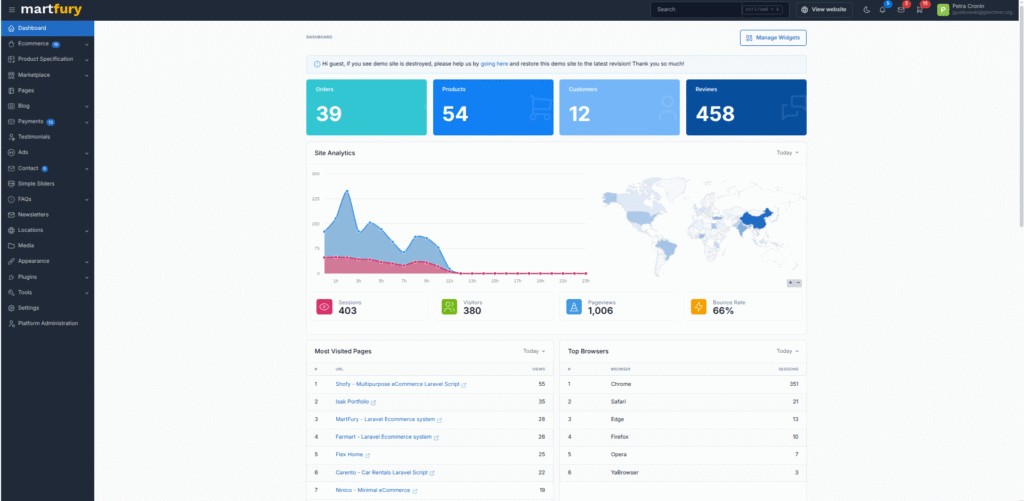
Vendor Dashboard & Capabilities
Each vendor on Martfury gets access to a dedicated dashboard designed to operate like an independent store within the marketplace.
Product management
Vendors can create, edit, and manage their own products, including pricing, stock levels, images, and descriptions. Attribute management allows vendors to handle variations such as size, color, or material without technical complexity.
Order handling
Vendors can view and manage orders related to their products, update order statuses, and track fulfillment progress. This separation ensures vendors only interact with their own transactions while customers experience a unified checkout process.
Earnings and payouts
The vendor dashboard provides visibility into earnings, commissions, and order history. Vendors can track revenue performance over time and request payouts according to the marketplace’s configured payout rules.
Product & Catalog System
Martfury includes a robust product and catalog system designed to scale with growing marketplaces.
Product types and variations
The platform supports both simple and variable products, making it suitable for physical goods, digital products, and mixed catalogs. Vendors can define product variations with custom attributes, enabling flexible pricing and inventory management.
Categories, filters, and attributes
Products can be organized into structured category hierarchies with advanced filtering options. Customers can filter listings by attributes such as price, category, or custom properties, improving discoverability and user experience.
SEO-friendly URLs
Martfury generates clean, readable URLs for products and categories. This structure helps search engines crawl and index marketplace content more efficiently, supporting long-term SEO performance.
Payments, Orders & Taxes
A multivendor marketplace must handle complex financial flows, and Martfury is built to manage them reliably.
Supported payment gateways
The platform integrates with multiple popular payment gateways, allowing customers to complete purchases securely. The payment flow supports both single-vendor and multi-vendor orders within the same checkout.
Order tracking and refunds
Orders move through a clear lifecycle, from placement to completion. Customers can track their orders, while admins and vendors can manage cancellations, returns, and refunds based on marketplace policies.
Tax and invoice handling
Martfury allows configurable tax rules and automated invoice generation. Invoices can include vendor, tax, and order details, helping marketplaces remain organized and compliant with regional requirements.
Design, UX & Localization
Beyond functionality, Martfury focuses on usability and global readiness.
Responsive themes
The marketplace frontend is fully responsive, ensuring a consistent experience across desktops, tablets, and mobile devices. Layouts adapt smoothly to different screen sizes without sacrificing performance.
Multi-language and multi-currency support
Martfury supports multiple languages and currencies, making it suitable for international marketplaces. This allows operators to reach global audiences while offering localized shopping experiences.
Mobile readiness
The platform is designed with mobile users in mind, ensuring fast load times and intuitive navigation on smartphones. This is critical for modern ecommerce, where a large portion of traffic comes from mobile devices.
Martfury Multivendor Marketplace Laravel: Technical Stack
One of the strongest reasons developers choose Martfury multivendor marketplace Laravel is its solid technical foundation. Unlike plugin-based ecommerce systems, Martfury is built directly on Laravel, making it easier to understand, extend, and maintain for teams familiar with modern PHP development practices. This section explains how Martfury leverages Laravel’s core components and why that matters for performance, scalability, and long-term growth.
Laravel MVC Structure
Martfury follows Laravel’s Model–View–Controller (MVC) architecture, which keeps business logic, presentation, and data access clearly separated.
- Models handle marketplace data such as users, vendors, products, orders, and commissions.
- Views use Blade templates to render the storefront, vendor dashboards, and admin panels.
- Controllers manage request flow, permissions, and interactions between users and the system.
This structure makes the codebase easier to navigate and modify. Developers can customize features, override behaviors, or add new modules without breaking core functionality. For agencies and long-term projects, this clean separation significantly reduces technical debt.
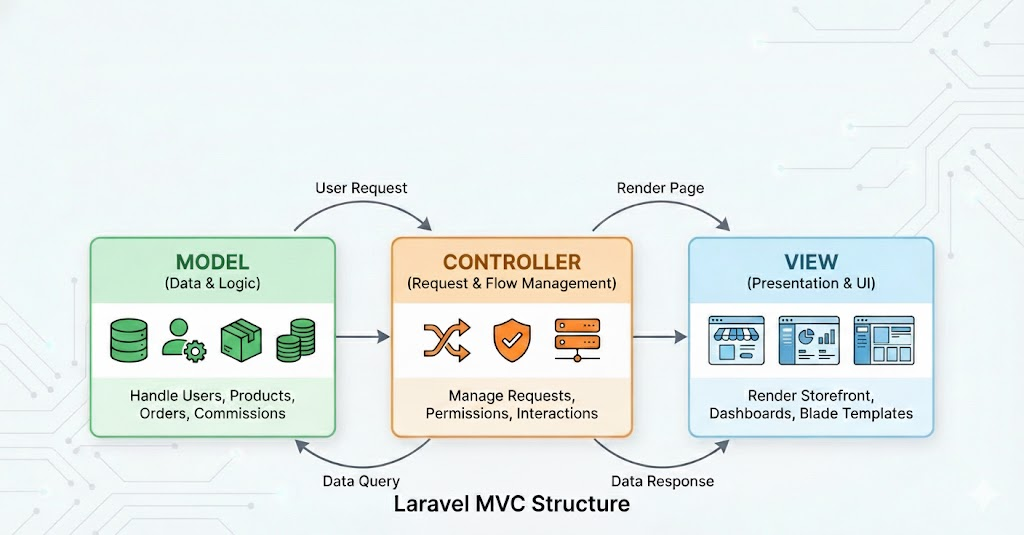
If you plan to customize or extend this system, following clean architecture principles is critical. You can explore proven Laravel best practices in this guide on writing clean code in Laravel.
Use of Eloquent ORM
Martfury relies on Laravel’s Eloquent ORM for database interactions, providing a clean and expressive way to work with complex marketplace relationships.
- Vendors, products, orders, and payouts are connected through well-defined model relationships.
- Common operations such as filtering orders, calculating commissions, or retrieving vendor-specific data are handled efficiently at the ORM level.
- Query scopes and relationships help keep database logic readable and reusable.
This approach improves developer productivity while maintaining performance, especially when dealing with large catalogs and high order volumes typical of multivendor marketplaces.
Queues, Caching & Performance Tools
Performance is critical for ecommerce platforms, and Martfury takes advantage of Laravel’s built-in optimization tools.
- Queues are used for background tasks such as email notifications, invoice generation, exports, and other time-consuming processes. This prevents slowdowns during checkout or admin operations.
- Caching helps reduce database load by storing frequently accessed data like settings, categories, and configuration values.
- Optimization tools such as route caching, config caching, and optimized autoloading help improve response times and scalability.
With proper server configuration, Martfury can handle increasing traffic and vendor activity without requiring a complete architectural rewrite.
API & Extensibility Overview
Martfury is designed with extensibility in mind, allowing developers to adapt the marketplace to custom business needs.
- The system exposes APIs that can be used for mobile apps, integrations, or external services.
- Developers can extend functionality by adding custom modules, services, or middleware within the Laravel ecosystem.
- Payment gateways, shipping logic, and third-party tools can be integrated without modifying core files.
This flexibility makes Martfury suitable for advanced use cases such as headless ecommerce, mobile-first marketplaces, or SaaS-style multivendor platforms.
Martfury Multivendor Marketplace Laravel Installation
After understanding Martfury’s technical stack and Laravel integration, the next practical question is how easy it is to install and get running. The Martfury multivendor marketplace Laravel script is designed for self-hosted environments, giving you full control over infrastructure, configuration, and deployment. This section covers hosting considerations, high-level installation steps, and common setup challenges you should be aware of before launching.
Hosting Requirements (Shared vs VPS)

Martfury can technically run on different types of hosting, but the choice of environment has a direct impact on performance and scalability.
Shared Hosting
Shared hosting may work for development, testing, or very small marketplaces with low traffic. However, shared environments often limit server resources, background processes, and queue workers. This can cause performance bottlenecks as vendors, products, and orders increase.
VPS or Cloud Hosting (Recommended)
A VPS or cloud server provides dedicated resources, better control over PHP versions, queue workers, and caching services. This setup is strongly recommended for production marketplaces, especially if you plan to scale. A typical setup includes:
- PHP 8+
- MySQL or compatible database
- Web server such as Nginx or Apache
- Optional services like Redis for caching and queues
Choosing a VPS ensures smoother checkout experiences, faster admin operations, and better long-term stability.
Installation Steps (High-Level)
Martfury follows a standard Laravel-based installation flow, which should feel familiar to most PHP developers.
- Upload the application files to your server.
- Create a database and configure environment variables.
- Install dependencies using Composer.
- Run database migrations and seeders.
- Set proper file and directory permissions.
- Configure the web server to point to the public directory.
Once these steps are complete, the marketplace becomes accessible through the browser, where further setup can continue through the admin interface.
Initial Configuration Checklist
After installation, some essential configurations are required before onboarding vendors or accepting orders.
- Set application URL, timezone, and locale.
- Configure email settings for notifications and password resets.
- Enable multivendor mode and define vendor registration rules.
- Set commission structures and payout preferences.
- Configure payment gateways and test transactions.
- Review tax and invoice settings based on your region.
Completing this checklist early helps avoid operational issues once vendors and customers start using the platform.
Common Setup Issues
Like most Laravel-based applications, a few common issues may arise during setup, especially for first-time deployments.
- File permission errors: Incorrect permissions can prevent uploads, cache generation, or log writing.
- Queue not running: Background jobs may fail if queue workers are not configured.
- Environment misconfiguration: Incorrect database credentials or application URLs can break core functionality.
- Email delivery problems: Misconfigured mail drivers can block account verification and order notifications.
Most of these issues are resolved by double-checking server configuration and following standard Laravel deployment best practices.
Customization & Scalability in Martfury Multivendor Marketplace Laravel
One of the biggest advantages of using Martfury multivendor marketplace Laravel is the freedom to customize and scale the platform as your business grows. Because Martfury is built on Laravel rather than a closed SaaS or plugin-heavy CMS, it gives developers and agencies full control over both the user experience and system performance. This section explains how Martfury supports customization today and scalability for future growth.
Theme and UI Customization
Martfury’s frontend is designed to be flexible and developer-friendly. It uses Laravel’s Blade templating system, which makes it easy to customize layouts, components, and visual elements without rewriting core logic.
- Developers can modify Blade views to adjust page structure, product layouts, or vendor storefronts.
- Custom CSS and JavaScript can be added to refine branding, interactions, and animations.
- UI changes can be isolated from backend logic, reducing the risk of breaking functionality during updates.
This approach allows marketplaces to maintain a unique brand identity while still benefiting from a stable underlying system.
Adding Custom Modules
Martfury supports modular development, making it suitable for marketplaces that require custom features beyond the default setup.
- New modules can be added to extend functionality such as custom payment flows, reporting tools, or vendor-specific features.
- Laravel’s service container and event system make it possible to hook into existing processes without modifying core files.
- Developers can introduce APIs, background jobs, or integrations with third-party services in a structured way.
This modular approach ensures that customizations remain maintainable and upgrade-friendly over time.
Performance Optimization Tips
As a multivendor marketplace grows, performance becomes critical. Martfury benefits directly from Laravel’s performance optimization tools when properly configured.
- Enable configuration and route caching to reduce request overhead.
- Use caching layers for frequently accessed data such as categories, settings, and vendor information.
- Run background tasks through queue workers instead of synchronous execution.
- Optimize database queries by using eager loading and indexing key columns.
These optimizations help maintain fast load times and smooth checkout experiences even as product counts and user activity increase.
Scaling for High Traffic
Martfury is well-suited for scaling when deployed on the right infrastructure.
- Vertical scaling allows you to increase server resources as traffic grows.
- Horizontal scaling can be achieved using load balancers and multiple application instances.
- Shared services like caching and queues can be moved to dedicated servers for better performance.
- Static assets can be served through a CDN to reduce server load and improve global response times.
With proper planning, Martfury can support high-traffic marketplaces without requiring a complete rebuild.
Long-Term Growth Considerations
Customization and scalability are essential for future-proof marketplaces. Martfury’s Laravel-based architecture provides the flexibility to evolve alongside your business, whether you’re launching new vendor features, expanding into new regions, or preparing for seasonal traffic spikes. This makes it a strong choice for teams that want both immediate functionality and long-term control.
Use Cases: Who Martfury Is Best For
Understanding who Martfury is best suited for helps align expectations and ensures the platform matches real business goals. Because Martfury multivendor marketplace Laravel combines a ready-made ecommerce foundation with developer-level flexibility, it fits a wide range of marketplace scenarios. Below are the most common and effective use cases.
Ecommerce Multivendor Marketplaces
Martfury is a strong fit for building traditional ecommerce multivendor marketplaces where multiple sellers offer physical products through a single storefront.
- Each vendor can manage their own products, inventory, and orders.
- The platform supports centralized checkout with vendor-level order separation.
- Admins maintain control over commissions, product approvals, and marketplace rules.
This use case works well for marketplaces modeled after large platforms, but hosted independently with full ownership over data and infrastructure.
Digital Product Platforms
Martfury is also suitable for digital product marketplaces, such as platforms selling eBooks, software, templates, or other downloadable assets.
- Vendors can list digital products without physical shipping requirements.
- Orders, payments, and delivery workflows can be adapted for digital fulfillment.
- Admins can manage commissions and payouts just like physical marketplaces.
For creators and platform owners who want to avoid SaaS fees and keep full control over their digital marketplace, Martfury provides a solid Laravel-based foundation.
Niche & Regional Marketplaces
Martfury works particularly well for niche or region-specific marketplaces, where customization and localization are essential.
- Multi-language and multi-currency support makes it easier to target regional audiences.
- Marketplace rules, tax logic, and product categories can be tailored to local needs.
- Smaller niche platforms benefit from faster time-to-market without sacrificing flexibility.
Examples include local artisan marketplaces, regional service-based platforms, or category-specific ecommerce sites.
Agency-Built Client Projects
For agencies and development teams, Martfury is an efficient solution for client marketplace projects.
- Agencies can reuse a proven codebase across multiple projects.
- Custom features and branding can be added per client without rebuilding core logic.
- Ongoing maintenance and scaling can be handled using standard Laravel practices.
This makes Martfury especially attractive for agencies delivering custom ecommerce or marketplace solutions on tight timelines.
Pros and Cons of Using Martfury
When evaluating a self-hosted marketplace solution, it’s important to look at both strengths and limitations. A balanced view not only helps with better decision-making but also builds trust. Below is an honest breakdown of the pros and cons of using Martfury multivendor marketplace Laravel, especially from a technical and business perspective.
Pros
Laravel-based flexibility
Martfury is built directly on Laravel, which gives developers full control over the codebase. This makes it easier to customize features, integrate third-party services, and adapt the platform to specific business requirements without being locked into a closed ecosystem.
Faster time to market
Instead of building a multivendor marketplace from scratch, Martfury provides a ready-made foundation. Core features like vendor management, product catalogs, payments, and commissions are already in place, allowing teams to launch much faster while still retaining customization freedom.
One-time license model
Martfury uses a one-time purchase model rather than recurring monthly fees. This is especially appealing for startups and agencies that want predictable costs and full ownership of their marketplace, without long-term platform charges eating into revenue.
Developer-friendly architecture
The platform follows Laravel best practices such as MVC structure, modular components, and clean separation of concerns. This makes the codebase easier to understand, maintain, and extend, particularly for teams already familiar with modern PHP development.
Cons
Requires Laravel knowledge
While Martfury simplifies marketplace development, advanced customization still requires solid Laravel and PHP knowledge. Non-technical users may find it challenging to make significant changes without developer assistance.
Customization takes effort
Although the system is flexible, deep customization is not instant. Adding custom workflows, complex integrations, or unique business logic requires planning, development time, and testing, especially for larger marketplaces.
Self-hosting responsibility
With full control comes full responsibility. Marketplace owners are responsible for hosting, security updates, backups, and performance optimization. This is an advantage for experienced teams but may be a drawback for those expecting a fully managed solution.
Martfury vs Popular Alternatives
When evaluating Martfury multivendor marketplace Laravel, it’s important to understand how it compares with other options you might consider. Below is a practical, SEO-optimized comparison that helps you make an informed decision based on capability, flexibility, and long-term goals.
Martfury vs Bagisto
Martfury
- Built specifically as a multivendor marketplace with vendor dashboards, commission rules, marketplace controls, and seller management out of the box.
- Simpler setup for marketplace use cases straight away — less configuration required for core features.
- Laravel architecture emphasizes modular components and customization through Blade views.
Bagisto
- Bagisto is an open-source ecommerce platform built on Laravel and includes marketplace features via extensions.
- Requires marketplace modules or plugins to enable multivendor features, meaning extra setup and occasionally additional costs.
- Better if you want a fully open-source stack without a premium script license, but initial configuration and customization may take longer.
Bottom line:
Choose Martfury if you want turnkey marketplace features with vendor workflows out of the box. Choose Bagisto if you prefer open-source freedom and community ecosystems, but be prepared for more setup and configuration work.
Martfury vs WordPress Multivendor Plugins
Martfury
- A Laravel native solution designed as a standalone marketplace system, not tied to a CMS.
- Offers better performance and deeper customization options for developers familiar with PHP and Laravel.
- No dependency on WordPress core updates, plugin conflicts, or theme constraints.
WordPress Multivendor Plugins (like Dokan, WC Vendors)
- Built on top of WooCommerce and WordPress. Best if you already use WordPress for content and want a simple multivendor addon.
- Easier for non-developers to manage initially because of familiar WordPress UI.
- May struggle with performance at scale without significant optimization because WordPress wasn’t originally architected for large marketplace applications.
Bottom line:
Pick Martfury if you want a dedicated, high-performance marketplace platform built from the ground up. WordPress plugins are good for smaller, content-driven marketplaces or users highly tied into the WordPress ecosystem.
Martfury vs Custom Laravel Build
Martfury
- Provides a ready-made marketplace codebase that includes admin controls, vendor systems, product management, payments, order handling, and more.
- Reduces development time significantly, and lets teams focus on unique differentiators rather than reinventing core multivendor logic.
- Updates and community support around a known marketplace pattern speed up iteration.
Custom Laravel Build
- Maximum flexibility — you design every piece of functionality from scratch, perfectly tailored to your business logic.
- Requires full engineering teams, design patterns, QA cycles, and significantly higher costs and timeline.
- You maintain responsibility for marketplace architecture decisions, scalability, and infrastructure choices.
Bottom line:
Go with Martfury if you want marketplace logic already built and extensible, saving months of engineering work. Choose a custom build only if your business model is so unique that off-the-shelf patterns won’t ever fit — and you have resources to invest heavily.
Summary Comparison Table
| Feature / Option | Martfury Multivendor Marketplace Laravel | Bagisto + Marketplace Module | WordPress Multivendor Plugins | Custom Laravel Build |
|---|---|---|---|---|
| Ready-made marketplace features | ✔ | Limited / Extension Needed | ✔ Yes but via plugins | ❌ (from scratch) |
| Customizability | High | High | Medium | Maximum |
| Performance & scalability | Strong | Medium | Variable | Depends on implementation |
| Time to market | Fast | Moderate | Fast | Slow |
| Developer-friendly architecture | ✔ Laravel | ✔ Laravel | PHP / WordPress | ∞ (fully custom) |
| Best for | Marketplaces | Flexible ecommerce | Small marketplaces with WP experience | Unique enterprise solutions |
Pricing, Licensing & Total Cost
When evaluating Martfury multivendor marketplace Laravel, understanding the pricing structure and total cost of ownership is key for decision-makers with commercial intent. This section breaks down the license type, ongoing expenses, hosting considerations, and the overall cost-effectiveness of using Martfury for your marketplace project.
License Types Explained
Martfury follows a straightforward premium licensing model for Laravel-based marketplaces. Instead of recurring subscription fees common with SaaS platforms, Martfury typically uses a one-time purchase license. This means:
- You pay once for the script.
- You receive the full source code with permissions to customize and deploy on your own servers.
- You can reuse the code for multiple marketplace projects when permitted by the license (depending on the marketplace’s policy).
This model gives you full ownership of your marketplace codebase and avoids recurring software charges.
One-Time vs Ongoing Costs
Understanding the difference between upfront and recurring costs helps you forecast long-term expenses:
One-Time Costs
- Martfury script purchase
- Initial development and customization
- Branding and UI design (if outsourced)
Ongoing Costs
- Hosting and server infrastructure
- Domain name renewal
- SSL certificates
- Maintenance, security patches, and updates
- Developer time for customization and upgrades
- Marketing, SEO, and platform support
Although the script itself is a one-time expense, running a production-grade marketplace carries ongoing operational costs. These are typical for self-hosted solutions and give you more control compared to SaaS platforms where ongoing fees may be higher.
Hosting & Maintenance Considerations
A critical part of total cost is hosting and ongoing maintenance:
Hosting
- Shared hosting may suffice for development or low-traffic launches but is not recommended for production marketplaces.
- A VPS or cloud server (e.g., AWS, DigitalOcean, or Google Cloud) provides better performance, scalability, and security.
- Consider using managed services, content delivery networks (CDNs), and caching layers to improve performance as traffic grows.
Maintenance
- Regular backups, security updates, and performance monitoring.
- Team or contractor costs for handling feature updates or Laravel upgrades.
- Support for payment gateways, tax rules, and vendor support processes.
Good hosting and maintenance practices ensure uptime and reduce the risk of data loss or security breaches, which are especially important for ecommerce platforms handling payments and personal information.
Is It Cost-Effective?
Whether Martfury is cost-effective depends on your goals and technical resources:
Advantages
- Lower recurring costs compared to SaaS marketplace platforms
- Full ownership of code and data
- No vendor lock-in
- Easier to scale and customize over time
Trade-Offs
- Requires technical expertise or a development team
- Self-hosting requires ongoing monitoring and maintenance
- Infrastructure costs can increase with traffic and growth
Martfury becomes especially cost-effective if you:
- Have access to Laravel developers or plan to build a technical team
- Want full control over branding, data, and infrastructure
- Plan to scale significantly over time without recurring software fees
In summary, Martfury’s pricing and licensing model positions it as a long-term investment rather than a short-term subscription. For founders and developers looking for an owned marketplace solution with flexibility and scalability, the total cost of ownership often compares favorably with hosted alternatives.
Martfury Worth It? (Decision Section)
Deciding whether Martfury multivendor marketplace Laravel is the right solution for your project goes beyond features and price — it’s about fit, long-term goals, and technical capabilities. Below is an honest evaluation to help you make that decision with confidence.
When Martfury Is a Good Choice
Martfury is an excellent option if you are looking for a self-hosted marketplace solution with built-in multivendor capabilities that can be customized and scaled over time. Here are situations where Martfury shines:
✔ You want full code ownership and data control
Unlike hosted SaaS platforms, Martfury gives you complete control over your marketplace codebase, database, and infrastructure. This means no recurring platform fees and no vendor lock-in.
✔ You have access to Laravel developers or technical resources
Because Martfury is built on Laravel, technical expertise allows you to extend functionality, optimize performance, and customize features exactly to your requirements.
✔ You need a faster time to market
Martfury provides ready-made marketplace workflows, vendor dashboards, and core administrative tools out of the box. This significantly reduces development time compared to building a marketplace from scratch.
✔ You plan to scale and customize over time
Whether you are targeting niche verticals or building a marketplace that will grow significantly, Martfury’s architecture supports long-term extension and performance tuning.
When You Should Consider Alternatives
Martfury is powerful, but it’s not a one-size-fits-all solution. Consider alternatives if your project aligns with any of the following:
⚠ You are non-technical and don’t plan to hire developers
Martfury requires Laravel knowledge for meaningful customization. If you prefer a plug-and-play solution with minimal technical involvement, a hosted SaaS marketplace or WordPress-based solution might be easier.
⚠ You need unique marketplace logic not supported by default features
While Martfury is extensible, extremely bespoke workflows (e.g., auction models, advanced subscription models, or complex financial splits) may require substantial custom development. In these cases, a custom Laravel build might be more appropriate.
⚠ You want full support and maintenance handled for you
If you’d rather pay for a service that handles hosting, security updates, backups, and uptime guarantees, a managed marketplace SaaS could be a better fit than a self-hosted script.
Honest Recommendation
Martfury is worth it when your priority is long-term ownership, customization freedom, and scalability with a Laravel-centric approach. It’s especially appealing to developers, agencies, and founders who want more than a template — they want a platform they can evolve over time.
At the same time, if you lack technical resources or prefer a fully managed environment where upgrades, security, and performance are handled by a third party, Martfury may not be the ideal first choice.
In short:
- Choose Martfury if: You want control, flexibility, and the ability to grow your marketplace without SaaS restrictions.
- Consider alternatives if: You want minimal setup overhead, managed hosting, or a simpler UI with fewer technical demands.
Security, SEO & Performance Considerations
For any production marketplace, long-term success depends on more than features alone. Security, search visibility, and performance directly affect trust, scalability, and revenue. The Martfury multivendor marketplace Laravel platform is well-positioned in these areas when deployed and managed correctly. This section highlights best practices and considerations to protect your investment and ensure sustainable growth.
Avoiding Nulled Scripts (Critical for Security)
Using nulled or pirated versions of marketplace scripts is one of the biggest risks for any ecommerce business.
- Nulled scripts often contain hidden malware, backdoors, or malicious code.
- They can compromise customer data, payment flows, and admin access.
- Search engines may penalize or blacklist infected sites, destroying SEO and brand trust.
From a security and compliance standpoint, always use a legitimate version of Martfury. This ensures access to updates, bug fixes, and compatibility with newer Laravel and PHP versions. For marketplaces handling payments and personal data, this is not optional—it’s foundational.
SEO Readiness & Optimization
Martfury is designed with SEO in mind, but results depend on proper configuration and content strategy.
- Clean, readable URLs for products and categories help search engines crawl content efficiently.
- Structured product and category pages support better indexing and ranking.
- Meta titles, descriptions, and headings can be customized to target long-tail ecommerce keywords.
- The platform supports scalable catalogs, which is essential for marketplaces with thousands of vendor products.
To maximize SEO performance, combine Martfury’s technical foundation with strong content practices, internal linking, and optimized category structures. This makes it easier to rank for buyer-intent and product-driven search queries over time.
Caching & Speed Improvements
Performance directly affects conversion rates and SEO rankings. Martfury benefits from Laravel’s built-in performance optimization capabilities when properly configured.
- Enable application-level caching to reduce repeated database queries.
- Use route and configuration caching to improve request handling speed.
- Offload background tasks such as emails and exports to queue workers.
- Optimize images and static assets to reduce page load times.
- Use a content delivery network (CDN) for global audiences.
These optimizations are especially important for multivendor marketplaces, where product volume and concurrent users grow steadily.
Why This Matters for Long-Term Viability
Security breaches, slow load times, or poor SEO can undermine even the best marketplace idea. By following secure deployment practices, investing in performance optimization, and maintaining SEO best practices, Martfury can serve as a reliable foundation for long-term marketplace growth.
For founders and developers focused on trust, scalability, and sustainability, these considerations are just as important as features and pricing—and they are areas where a Laravel-based, self-hosted solution like Martfury can perform exceptionally well when managed correctly.
Frequently Asked Questions (FAQ)
Is Martfury free?
No, Martfury is not a free marketplace solution. It is a premium Laravel-based multivendor ecommerce script that requires a one-time purchase. In return, buyers receive the full source code, access to updates, and the ability to host and customize the marketplace independently.
Is it suitable for non-developers?
Martfury is not ideal for non-developers who want a fully plug-and-play solution. While basic configuration can be handled through the admin panel, meaningful customization and long-term maintenance require Laravel and PHP knowledge or access to a developer. For non-technical users, managed SaaS marketplaces may feel easier initially.
Can it handle large marketplaces?
Yes, Martfury can handle large marketplaces when deployed on proper infrastructure. With optimized hosting, caching, and queue management, it can support high product volumes, multiple vendors, and increasing traffic. Scalability largely depends on server resources and deployment practices rather than platform limitations.
Is Martfury SEO-friendly?
Yes, Martfury is SEO-friendly at the technical level. It supports clean URLs, structured product and category pages, and customizable metadata. When combined with good content strategy and performance optimization, it can rank well for both informational and commercial ecommerce keywords.
Final Verdict & Next Steps
Martfury offers a strong balance between ready-made marketplace functionality and developer-level flexibility. Its Laravel-based architecture, built-in multivendor features, and one-time licensing model make it appealing for teams that want long-term control without recurring platform fees.
Summary of strengths and limitations
Strengths
- Laravel-native architecture with clean, maintainable code
- Built-in multivendor workflows and admin controls
- Faster time to market compared to custom development
- Full ownership of code and data
Limitations
- Requires Laravel knowledge for advanced customization
- Self-hosting adds maintenance responsibility
- Not ideal for users seeking a fully managed solution
Who should buy it
Martfury is best suited for Laravel developers, agencies, and founders who plan to build or scale a custom multivendor marketplace. It’s especially valuable for those who want flexibility, ownership, and the ability to grow without SaaS limitations.
